Gyuto vs santoku: what are the differences?
We are often asked: what is the difference between a gyuto and a santoku? Understandably so, as both knife styles originate in Japan and are true all-rounders in the kitchen. Yet they feel very different in use. The biggest difference lies in the shape of the blade, the cutting technique and the style of the knife.

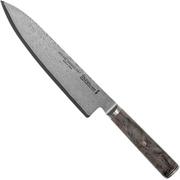
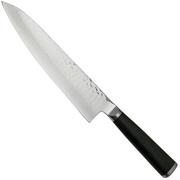
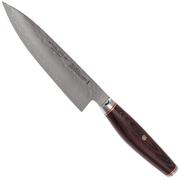
Gyuto knife
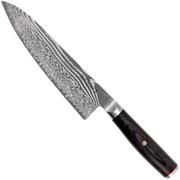
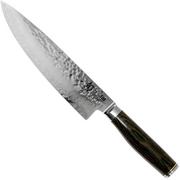
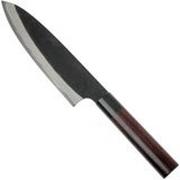
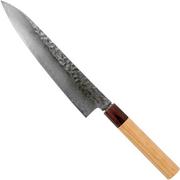
Gyuto knives are often seen as the Japanese answer to European chef's knives. Or, simply put: a chef's knife, but in a Japanese style.
The gyuto originated in Japan at the end of the 19th century, during the Meiji period. At that time, Western eating habits and cooking methods were becoming increasingly popular. There was more focus on meat preparation and, with it, on the European chef's knife. Japanese knifemakers took that shape as their starting point and gave it their own twist. The result: a versatile knife for meat, fish and vegetables, but with the refinement you expect from Japanese kitchen knives.
The origins of this knife style lie in Japan, but that does not mean every gyuto is made in Japan. Today, manufacturers from other countries also use this term for knives with the same blade shape and cutting characteristics.
A gyuto often has a thinner blade, a harder type of steel and a sharper edge than many European chef's knives. As a result, it often cuts more lightly and precisely. The name gyuto literally translates to "cow sword", reflecting the knife’s original focus on meat preparation. A gyuto is characterised by its pointed tip and slightly curved edge. That shape makes the knife very versatile. You use the tip for precise cutting work, while the length of the blade is useful for larger ingredients.
The curved edge makes a gyuto well suited to the rocking cutting motion. Ideal for finely chopping herbs, garlic or nuts. Long, smooth cutting motions also work well with this type of knife. A gyuto is essentially used in the same way as a chef's knife. Read more about this cutting technique here.
A gyuto usually has a blade length of 18 to 24 cm. As a result, a gyuto is often slightly longer than a santoku. The extra length provides more reach on the cutting board, but also requires a little more space and control.








Santoku knife
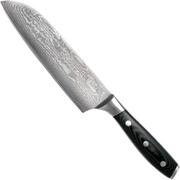
Santoku knives may well be the best-known Japanese all-purpose knives. The name santoku refers to preparing three types of ingredients: vegetables, meat and fish.
The blade of a santoku is usually shorter and taller than that of a gyuto. The edge is fairly straight and the tip slopes down from the spine of the blade. This allows the knife to sit stably on the cutting board and makes it easy to use the full length of the edge.
Like the gyuto, the santoku is broadly versatile, but the way you cut with it is different. A santoku is especially suitable for the push-cutting technique. With this, you move the knife diagonally forwards and downwards, lift it and bring it back to the starting position. This technique works quickly and with control, especially with vegetables. The broad blade also makes it easy to scoop cut ingredients off the cutting board.
Most santokus have a blade length of 16 to 18 cm. As a result, they feel compact, agile and approachable. Ideal for those who prefer working with a slightly shorter knife.

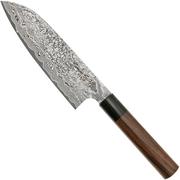

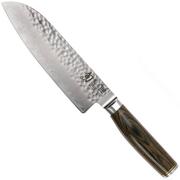

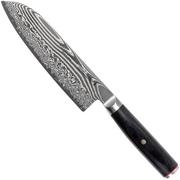

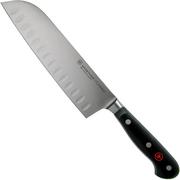

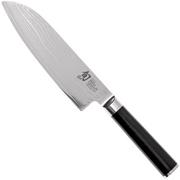

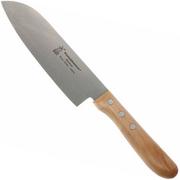

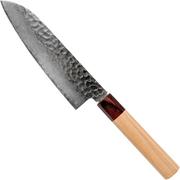

Which of the two will you choose?
A gyuto is not better than a santoku. And vice versa. The difference mainly lies in your cutting style. Do you like cutting with longer, fluid motions or do you often use a rocking cutting technique? Then a gyuto will probably suit you well. Do you prefer to work in a compact, controlled way and mainly with downward or pushing cutting motions? Then a santoku is a logical choice.
Do you cook a lot and want one versatile Japanese knife? Then both knives are excellent options. The gyuto feels a bit more like a classic chef's knife, while the santoku feels more compact and direct. Ultimately, it comes down to feel: the best knife is the one that suits your way of cooking.
Unable to find what you were looking for? View all Japanese knives here.


